Saturday, March 12, 2011

Two Faces...Same Coin


          VS        


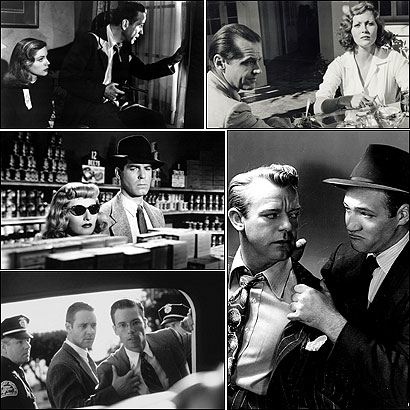
There are several differences between classic noir and neo noir films. Some of them can be that the classic noir was in black and white versus neo noir in color, noir films were created in the early '40s and associated with with World War II while neo noir movies were produced in the late 20th century. Obviously the scenarios changed, while noir has a lack of space, hotel rooms or urban streets, might because the budget. Neo noir is film in places with more room and its lines are based in real situations as political, social or general life. In addition, the narrative which is present in noir mode is not longer used for the modern noir films, the author of  The Dark Past Keeps returning: Gender Themes in Neo-Noir, Heather borrows the quote "Form is fragmented, narratives are discontinuous, and absolute truth is meaningless" (Salim). I do know exactly why, but might be because the scenes are more understanding so the narrative is not necessary.  Either classic noir and neo noir characters have different roles but the same freaky intention: manipulate with their emotions to accomplish their goal.
Noir male protagonist do everything for the femme fatale desires until both are destroyed for their own human nature. Neo noir story-tales apparently are based either to find how to be a real man or how the roles of man an woman has affected femaleness. Some of the actors are not longer guided for a woman instead they are driven for a male. Like in the case of Fight Club, where Jack in his intent to avoid Marla, he finds himself being guide by Tyler, to whom he sees as a teacher of his life. Moreover, Tyler has the theory of "Manhood is lost because we were raised for a woman, and then later for another woman, a wife." In my humble opinion this Tyler wants to create and raise kids without female figure.

Based to what I comprehended, it looks like there are two types of female protagonists involved in the neo noir films. Either she plays the role of whom makes men's life miserable and she is see just as sexual object or as the classic noir femme fatale with the difference that she neither died nor change her life style. Such characters can be appreciate in the movie "Fight Club"  and "The Last Seduction". Where in the first movie mentioned before, Marla plays the only female persona, a woman that confronts en several occasions the rejection from men. And the other side, The Last Seduction film, Bridget as a femme fatale killed her husband and her lover paid the consequences of such crime. This scenario is as same as classic noir, but here Bridget left without to pay for her evil actions and with money in her packet.
As the quote that Heather Fireman took from Marla San Felippo "The Last Seduction reflects anxieties about current feminist advances, examining masculinity and femininity in light of deconstructed and reconstructed gender roles." Therefore, female characters have something else in their minds than being beautiful, treacherous, and being killed. They play to be alive with glory and money.
Lack of colors versus color films, predatory characters, and different budget are some of the descriptions of Classic Noir and Neo Noir, however the tale of the fisherman and the fish is the same, I think that later on we will see who is the fisherman and who is the prey... 


Sunday, March 6, 2011

Almost Done...

     Sometimes story-tales are based in true stories and Double Indemnity has something of it. A case ocurred in the last '20s era. Where a woman in plot with her lover killed her husband to collect a insurance policy. As same as the novel the victim was not aware of such insurance and the sum was almost of $100,000. The case was knew as Snyder and Grey. Moreover, V. Penelope Pelizzon and Nancy M West, authors of Multiple Indemnity: Film Noir, James M. Cain, and Adaptations of a Tabloid Case, commented that it looked like J.Cain recreated what the documentals of that time stated regarding to that case. Later on, with the film the whole story was refurbished.


     Everything happended in the city of Queens, New York the morning of March 20, 1927. The forty-four year-old art editor Albert Snyder was found death is his bedroom. All appeared that the killers used a regular and simple home furniture as a weapon to accomplish their objetive...a They did not have any mercy to kill Mr. Snyder. Followed he suffered strangulation her nose was covered with chloroform-soaked cotton. People who were closed to him did not believe of such cruel was commited against Mr. Snyder. Although her wife, Mrs. Ruth Snyder, tried to cover everything like an assault, it took some hours to the police to find out that she had planned the crime together with her lover, Judd Gray. In one side of the story Ruth attempted to guard herself claiming that the whole plan was made it by Gray. Even she blamed him of her infidelity against her husband. In the other side, Gray pointed the finger at her, claiming that he felt in her tramps of femme fatale, seductively and beautiful but treacherous. The whole story was involved with one person, a person who likes evil, mysterious, which gives the same value to love or kill by pleasure. She is a femme fatale, where Ruth Snyder fitted perfect in Phillys Dietrichson character.    
 J. Cain added some of reality in his novel and Wilder was in charged of pulish the lines, together made one of the most famous film noirs of the '40s era.

Wednesday, February 23, 2011

Phyllis Nirdlinger's past stimulated her to execute a murder after another murder as Walter Huff was goaded to make the same mistakes over and over without learn from them. Maybe Walter thought that when Phyllis told him that she felt herself as the death, it was the first time of the type of feeling in her; therefore, he never had a second thought that she had been committed murders before that conversation. After, Lola told him who was in reality Phyllis, he realized all the evil things that he did for an unreliable women and money which were not on his hands. Lola's sweetness and innocence before Mr. Buff's face made him felt miserable as a sewer rat. He had been killed her dad ! and she was trusting everything on him. Now he was falling in love with her as a teenager in high school, even he was dreaming to married her and live a happy life as nothing happened. He had more than moral corruption, he was mental sick without feeling any guilt. All the characters started to play the game "the cat and the mouse",
 until they were together at the same place and at the same time: Griffith Park.
Lola thought was following Sachetti's foot steps, Mr. Sachetti was following Phyllis to see what was happening regarding Phyllis and Griffith Park relation, Phyllis was attempting to achieve her next crime, and Mr. Huff was trying to kill for whom he was involve in all this situation, Phyllis.
He went to catch the fish and he ended up being the fish.
At the end of the story, Walter and Phyllis were together again, different scenario but the same feelings. They were looking each other with an ax in their hands.
"Primary Characteristics and Convention of Film Noir: Themes and Styles" gives some descriptions as ambiguity and disenchantment which in my opinion are the characteristics that stand up. And the way I opened my blog it has relation with the next quote "The protagonists in film noir are normally driven by their past or by human weakness to repeat former mistakes".

Sunday, February 20, 2011

Who is Against of Whom

Film noir's female protagonists are described by "Primary Characteristics and Conventions of Film Noir" Themes and Styles" by loving women or femme fatales. The article of "The Neo-Noir '90s" illustrates the women role as "The women ambiguous, sexi and treacherous" (68), femme fatales. As well as Raymond Borde and Etienne Chaumenton described femme fatale as "Frustrated and deviant, half predator, half prey, detached yet ensnared, she falls victim of her tramp...This new type of women, manipulative and hard bitten, has her environment, ready to trade shots with anyone...We are a long way from the chaste heroines of the traditional western or historical drama."
 
The character of Phyllis Nirdlinger suits with those type of descriptions. The way which she explained to Mr. Huff  how risky is the place where her husband works "He's in the Petroleum Building, isn't he?...but most of the time he's in the oils fields. Plenty dangerous knocking around there" (Cain 12) Predatory and Manipulative
Mr. Nirdlinger has her own opinion how miserable her husband's life is "He's not happy. He'll be better off-dead" (Cain 18)
Her hunger to satisfy her evil emotions "Maybe I'm crazy. But there's something in me that loves Death. I think myself as Death...I'm so beautiful, then. And sad.. Walter, this is the awful part. I know this is terrible. I tell myself it's terrible. But to me, it doesn't seem terrible." (Cain 18)


A simple drop off of a renewal auto insurance took Mr. Huff to a relationship with the Death. She was not  just gorgeous, she was predatory and knew how to use her beauty to involve him in her planes to kill her husband. Even though Mr. Huff took a second thought regarding the attraction that he felt for her " I looked into the fire a while then. I ought to quit, while the quitting was good, I knew that. But that thing was in me, pushing me still closer to the edge" (Cain 15). He did not do nothing about planning with her the way they would murder him.  As the article of "Primary Characteristics and Conventions of Film Noir: Themes and Styles" describes film noir "The primary moods of classic film noir were melancholy, alienation, bleakness, disillusionment, disenchantment, pessimism, ambiguity, moral corruption, evil, guilt, desperation and paranoia." Where the characteristics of desperation and paranoia stand in that scene. After they left Mr. Nirdlinger's body on the train tracks, their anxiety of what they have done started to show. She was trying to drive and he was telling her the next steps to follow, but her emotions did not allow him to get along with her "Then you'll have to stop at the drugstore. To get a pint of ice cream or something...You got to say something to fix the time and the date.You--" "Get out! Get Out! I'll go insane!" (Cain 53). Moreover, that same article mentions that pessimism and anxiety are part of film noir setting. Although he had told her that she needed to take him where his car was, she continued with the same paranoia "When she got to my car ... We didn't kiss. We didn't even say god-bye.I got out of her car, got in mine, started, and drove home" (Cain 53). After the night, Mr. Huff's feelings changed "That's all it takes, one drop of fear, to curdle love into hate" (Cain 54).
Their own fears began to betray them. They were emotionally apart but at the same time tide as Mr. Nirdlinger's corpse was.

In the Double Indemnity tale is as clear as the water who takes the role as detective is Mr. Keyes, head of the Claim Department. Mr. Huff describes Keyes as a wolf when a false claim is knocking at the company's door. The authors Borde and Chaumeton say "The private detective is midway between lawful society and the underworld, walking on the brink, sometimes unscrupulous, but only putting himself at risk, fulfilling the requirements of his own code and the genre as well." When Mr. Norton told  Keyes that this case was a suicide, Keyes almost jumped on him to say "Mr. Norton, here's what the actuaries have  to say about suicide. You study them, you might find out something about the insurance business." (Cain 59). Norton's defense a such act was to say that he has  grew up around  this type of business and Keyes replied to him " You were raised in a private school...While you were learning how to bow oars there, I was studying these tables" (Cain 59). He also told him how to press on  Phyllis to the edge of this case so she can confess. Moreover, Keyes suggested to Norton to arrest her for 48 hours so she could not have communication with her accomplice. Although he was against of that type of practice, he knew that it was the only way to fight for that false claim. His character lead him probably be risky but worth it. His years of experience working as head of the claim department allowed him to coincide that Mr. Nirdlinger never was in the train, as he was not. Even though he was not hundred percent right about  her and his co-conspirator did the night of the crime, he was more likely to be close to what happened. Therefore, it is not a doubt that Mr. Keyes plays the detective's role as Mr. Nirdlinger was murdered at the age of 44 years.
Borden and Chaumenton portray film noir qualities as "nightmarish, weird, erotic, ambivalent, and cruel" and such descriptions fit pretty well in Double Indemnity tale.

Wednesday, February 16, 2011

Trading Car Insurance by Client $$$

 The story line of "Double Indemnity"  is about an insurance agent (Mr. Huff) who in his eagerness to find one of his clients (Mr. Nirdlinger) to renew his car coverage, found a lady, Mr. Nirdlinger's wife (Mrs. Phyllis Nirdlinger) with whom starts more than a simple client relationship. Mr. Huff and Mrs. Nirdlinger together with Miss Lola Nirdlinger, Mrs. Nirdlinger's step-daughter, are the characters of this tale where film noir style is notable. In one side Mr. Huff was trying to make money through selling auto insurance and the other side, Mrs. Nirdlinger found the perfect piece to carry out her mission: kill her husband.

     In his attempt to renovate his client car insurance, Mr Huff found himself having a conversation with Mrs. Nirdlinger. A women that the last thing which can be a worry for her was to talk about insurances. Mr Huff did not have another option but to continue with the dialogue. While his mind was poundering how he could  use her to Mr. Nirdlinger renew the coverage, he realized something that he did not see before. James M. Cain relates in his novel "Under those blue pajamas was a shape to set a man nuts,...I started explaining the highs ethics of the insurance business I didn't exactly know" (6). Mr Huff realized that Mrs. Nirdlinger was the type of women who had the power to make importants decisions.
Like "Primary Characteristics and Conventions of Film Noir: Themes and Styles" author describes "The fales in film noir were either of two types (or archetypes) - dutiful, reliable, trustworthy and loving women; or femme fatales - mysterious, duplicitous, double-crossing, gorgeous, unloving, predatory, tough-sweet, unreliable, irresponsible, manipulative and desperate." (Tim Dirks). Those features are simple to see in one hand with Miss Lola's character:
  • In the scene when Mr. Huff gave a ride to Miss Lola "I set down there, and after she got out, she reached out her hand, and took mine, and thanked me, her eyes shining like stars" (27) Loving Women
  • Another one is when Walter gave a loan on her boyfriend's car "You're awfully nice to me. I don't know why I keep bothering you about things" "That's all right, Miss Mirdlinger, I'm glad--" and her sweet answer was "You can call me Lola, if you want to" (30) Dutiful
And in the other hand with Mrs. Nirdlinger's character:
  • "But all of a sudden she looked at me, and I felt a chill creep straight up my back and into the roots of my hair. "Do you handle accident insurance?" (6)  Mysterious
  • "Maybe that don't mean to you what it means to me...You get calls for other kinds,...but never for accident." (6-7) Manipulative
  • "She had on a white sailor suit, with a blouse that pulled tight over her hips...I wasn't the only one who knew about that shape. She knew about herself, plenty." (10) Gorgeous
  • "He's in the Petroleum Building, isn't he?...but most of the time he's in the oils fields. Plenty dangerous knocking around there" (12) Predatory and Manipulative
  • "Mr. Huff, would it be possible for me to take out a policy for him, without bothering him about it at all" (12) Duplicitous, Tough-sweet and Manipulative
In addition, describing the females protagonist, that same article says "She would use her feminine wiles and come-hither sexuality to manipulate him into becoming the fall guy - often following a murder." ( ). Ansen, David, Tara and Weingarten illustrated femme fatale by "The women anbigous, sexi and treacherous." (68)
  • "She looked at me...and her face was about six inches away. What I did do was put my arm around her,pull her face up against mine, and kiss her on the mouth, hard...She gave it a cold stare, and then she closed her eyes, pulled me to her, and kissed back." "I rumpled her hair, and then we both made some pleats in the blouse" (13)


  • "You're going to drop a crown block on him." [Mr. Huff], "Well, you know, maybe not a crown block. But something. Something that's accidently-on-purpose going to fall on him, and then he'll be dead." (16)
  • "He's not happy. He'll be better off-dead" (18)
Raymond Borde and Etienne Chaumenton described femme fatale as "Frustrated and deviant, half predator, half prey, detached yet ensnared, she falls victim of her tramp...This new type of women, manipulative and hard bitten, has her envorimetn, ready to trade shots with anyone...
  • "Maybe I'm crazy. But there's something in me that loves Death. I think myself as Death...I'm so beautiful, then. And sad.. Walter, this is the awful part. I know this is terrible. I tell myself it's terrible. But to me, it doesn't seem terrible." (18)
In the other hand Borde and Chaumenton give the characteristics of the male protagonist as "He is often enough masochistic, even self-immolating, one who makes his own trouble, whom may trow himself into fear, niether for the sake of justice nor from avarice but for simple out of morbid curiosity"
  • When Mr. Huff told Mrs. Nirdlinger that aside from her, and money would be the other reason. She told him "You mean you would--betray your company, and help me do this, for me, and the money we could get out of it?" and his answer was "I mean just that" (18)
Moreover those authors mention how police is involve "If the police are featured, they are rotten"
and in the  Mr. Huff described them to Phyllis by "The police know who they are, of course. They round them up, give them the water cure--and then they're habeas corpused into court and turned loose. Those guys don't get convicted" (21)

Step by step                     rather than page by page
                                                                            

 we can see how this story-line convinces us that is a film noir form.

Sunday, February 13, 2011

Learning about "noir"


Before of "The Neo-Noir 90s" reading I did not know about the meaning of noir, but after I read the article, several times, and did some research in the internet I had a better idea of noir's meaning.

I remember watching some Mexican movies from that time of period, 40s and 50s, and the noir style was notirious. Neo noir article describe how in the film noir, the gloomy mood, martinis and cigarettes were of  present.
 Crime and suspense were a key of the film noir as well as the black and white colors invited the shadows to be present.  Such visual style was mainly brought from the old continent, Europe, by some Germans and Austrians who escaped from the Nazism; even though, the noir vision was in part move by American hard-novelists as Raymond Chandler, Dashiell Hammett and Cain (I am sure that I will learn about them in this course). Wet streets, fogbound and threatening as well as the sexy women but false were the atmosphere of this type of film. The glamour which film noir inspired it can be seen is the '40s-era monkey-fur jacket or at Camel advertise where an image of a provoking the audience to danger.
 The demand of teenagers displaced  film noir out of cinematography,where today huge budgets are required and shadow-draped are not more atractive .
Even though film noir does not generate
,

directors like the idea and concept of noir.  As "The Neo-Noir '90s" mentioned,  "many of our most talented young filmmakers began in a noir mode"